BY ROD JONES
OCU MARKETING & COMMUNICATIONS
Here’s a healthcare paradox in a nutshell: United States hospitals are facing a historic nursing shortage, yet nursing schools across the country routinely turn away qualified applicants. The issue isn't a lack of space or student interest. It’s a critical shortage of nursing faculty.
The cites a few key reasons for the shortage of nurse educators, including an expected wave of faculty retirements over the next decade.
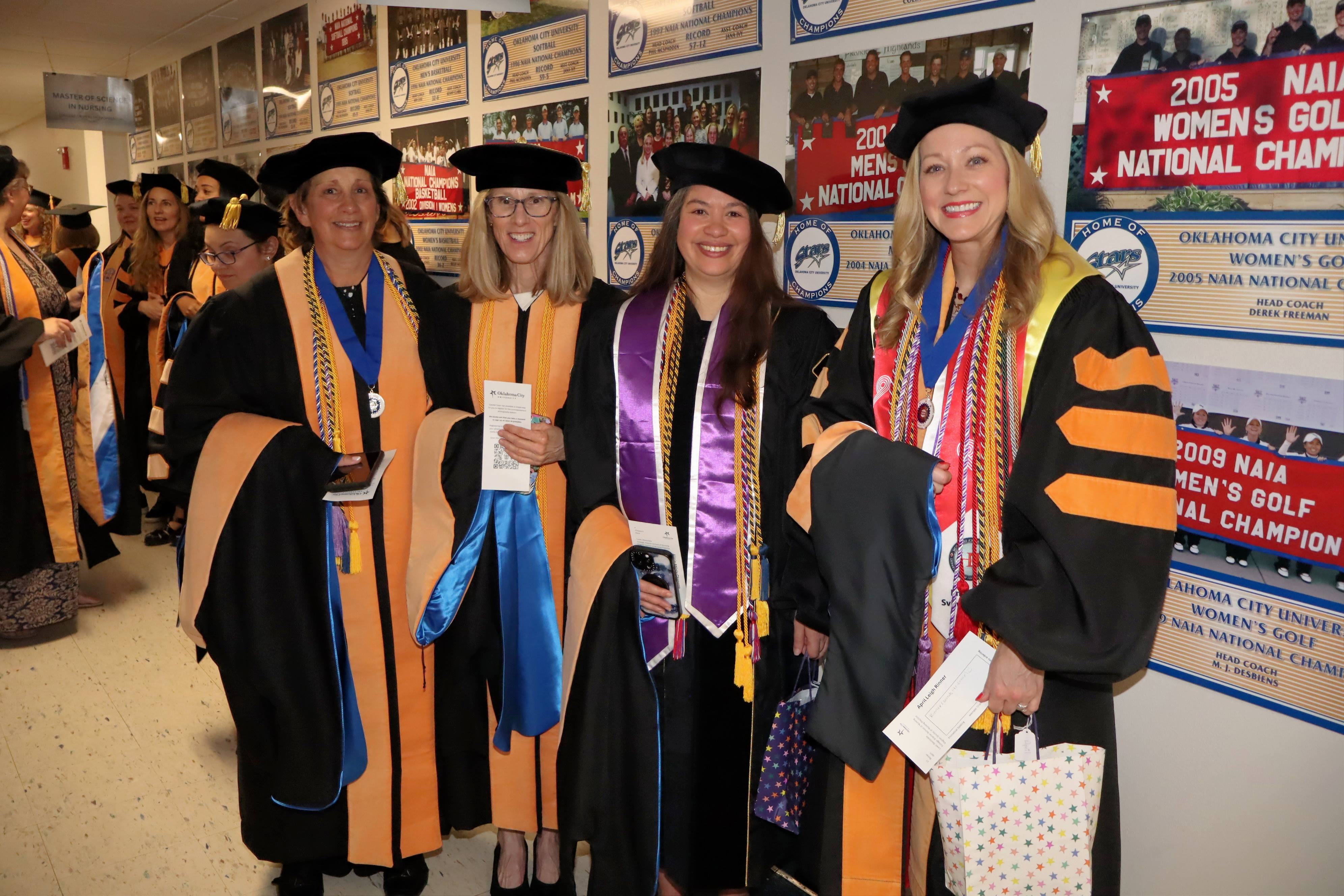
To confront this challenge head-on, the Kramer School of Nursing launched its Doctor of Nursing Practice (DNP) Nurse Educator track. This summer, the pioneer group of nurse educators is crossing the finish line as the program's very first graduating cohort. While they walked the stage at commencement earlier this spring, their degrees will officially confer this August, marking a massive milestone for both the university and the future of healthcare education.
A tight-knit, virtual community
Completing a doctoral program can be a grueling endeavor under any circumstances. Doing so while working full time and managing a family requires serious time management skills and patience.
With that in mind, OCU administrators designed the DNP Nurse Educator track for nurses who already hold a master’s degree with curriculum delivered primarily online to accommodate demanding professional schedules.
Yet, despite the mostly virtual format, the inaugural cohort of four students forged a bond and created an internal support group.
"We have become close friends, and we really just always rooted for each other," explained April Rinner, one of the graduating students from the Tulsa area. "It was never a competition. It was always, 'How can I build up the next person?' Because in nursing education, that’s what we do. We build up future nurses."
Dr. Michelle Johnston, chair of Advanced Practice Graduate Programs at Kramer, also recognized the close bond between the virtual classmates.
"They really made themselves a cohort and supported each other," Johnston said. "They are all from different areas of the state and brought different degrees of educational experience. Some work in clinical settings, others with bachelor's or associate degree programs. But they clicked. They credit each other for helping them get through, which isn't necessarily what you expect from an online program."
Consuming research, changing systems
While a Ph.D. in nursing typically focuses on generating new theories and ideas, the DNP is an applied doctorate. It empowers doctoral-prepared nurses to take existing evidence-based research and come up with innovative solutions to improve healthcare outcomes and help stabilize systems.
The immediate utility of the degree was evident during the cohort's final doctoral project presentations. One student designed a comprehensive, eight-week mentoring module specifically to support and retain new nursing faculty, addressing the high turnover rates plaguing nursing education.
"Seeing what they implemented, and really also their joy in it, was incredible," Johnston shared. "To them, nursing education is a passion."
Overcoming the past to guide the future
For Rinner — a mother of four boys ages 5 to 13 who balances roles as a school nurse, adjunct clinical faculty for Saint Francis Health System, and adjunct faculty for the University of Tulsa and the University of 91ż´Ć¬ — the path to a DNP was especially personal. As a first-generation college student of Native American heritage, her educational philosophy was shaped by an early childhood setback. In the third grade, a teacher mistook her quiet demeanor for a lack of ability and moved her to a lower academic track. Though she quickly proved the placement wrong, that experience left a permanent impression.
"I've always remembered that as an educator," Rinner said. "Some students are too afraid to speak up. They might be highly intelligent, but they don't learn like everybody else. My passion focus is that I don't ever want to fail to see potential. If teachers are approachable and students know we care, that’s half the battle."
Nursing wellbeing
That empathy is the bedrock of her 100-page doctoral project titled “Cultivating Empowered Novice Nurses: Supporting Mentors by Championing Well-Being.” Pilot-tested at a hospital in Tulsa, her doctoral project tackles the pervasive issue of nurse burnout, specifically targeting the high turnover window of a nurse's first year on the job. Her project draws a sharp line between traditional preceptors, who teach technical skills, and true mentors, who provide emotional and professional safe harbors.
Rinner’s project found that hospitals frequently align new graduates with veteran nurses who are already suffering from severe burnout, or "emotional hardening," from trauma and workplace stress. Her project introduces frameworks to assess and invest in the well-being of the mentors first, ensuring they are mentally and spiritually equipped to guide the next generation.
"To be able to pour into others, you cannot pour from an empty cup," Rinner noted, echoing Kramer’s curriculum emphasis on holistic and spiritual health. "My heart is for the new grad, but it’s also for these veteran nurses. If we don't prepare the mentor, we just set up a negative ripple effect."
Cultivating leaders for a global landscape
Beyond mentorship, the Kramer School of Nursing’s 30-to-32-credit-hour curriculum intentionally weaves transcultural healthcare and holistic thinking into its coursework. Whether navigating global health crises like recent viral outbreaks or understanding why a Native American patient might prefer traditional herbal remedies alongside modern medicine, Kramer graduates are trained to respect diverse backgrounds.
"We want to make sure our students are familiar with assessing culture," Johnston said. "But more importantly, we want them to carry that awareness into their interactions with their future students when they leave us."
The school's highly experienced faculty, the majority of whom are Certified Nurse Educators with decades of teaching experience, served as collaborative mentors to this first cohort, adjusting and refining the brand-new track in real time based on the students' professional feedback.
Looking ahead
As the inaugural four students prepare for the formal conferral of their doctoral degrees this August, a second cohort is already well underway, scheduled to graduate in the summer of 2027. They’ll join a profession that the expects to see 17% growth over the next eight years, a rate well above the 3% growth for overall teaching occupations.
The goal of OCU’s DNP Nurse Educator track is to create a self-sustaining ecosystem of exceptional educators who know how to solve problems, protect their peers from burnout, and welcome a diverse pipeline of new talent into the field.
When asked about the ultimate takeaway from watching this first cohort cross the finish line, Johnston didn’t hide her pride: "In the end, I just thought, 'We can change the world.'"
