
Note: This is the second part of a continuing series of stories taking a behind-the-scenes look at the 91¿´Æ¬ School of Music production of “Anastasia.â€�
BY ROD JONES
OCU COMMUNICATIONS
Costumes
In the basement of 91¿´Æ¬â€™s Kirkpatrick Auditorium, a small army of designers and stitchers is currently engaged in a massive logistical puzzle. They aren't just making clothes. They are building a time machine.
To the audience, “Anastasia� is a sweeping epic of a young girl searching for her true identity. To the costume crew, it is at least 550 individual articles of clothing — from Imperial Romanov jewels, to the jazzy styles of Roaring ’20s Paris, to the rags of communist Russia — all of which must be tracked, tailored and occasionally distressed with a healthy dose of artistry.
Three worlds collide
While the audience sees the show as a contrast between Russia and Paris, the design team sees it as three distinct visual layers:
- Imperial Russia: The world of the Romanovs, defined by opulence, heavy embellishment and royal grandeur.
- Bolshevik Russia: A utilitarian, drab world. (Ironically, the crew says making clothes look this bad is the most fun. "Distressing" involves painting over or roughing up their work to make them look grimy and lived-in.)
- 1920s Paris: Anya’s "dreamland." This is where the color returns, featuring vibrant flapper dresses, tassels and the iconic Neva Club looks.
The couture grind
Every costume in this production is effectively a piece of couture. Because everything is made for specific actors’ measurements, nothing is directly off the rack. The process is split into categories (or a combination thereof): Pull, Modify, Buy and Build.
"You start with 'Pull' because pull is free,� said Alysaa Couturier-Herndon, head of costumes for OCU, referring to finding a suitable costume in the on-campus storage facility. “Then you modify — like adding trim to a vest. If we can't find it, we buy it. And if those options aren’t available, we do what we love to do — build it from scratch."
For some students, these builds are the foundation of their future careers. One advanced technical student is currently patterning and building Anya’s Finale Dress from scratch, a massive undertaking involving intricate appliques that will serve as the centerpiece of her professional portfolio.
That doesn’t necessarily mean the less extravagant communist Russia-era costumes are a walk in the park.
“I honestly feel like it's just as hard to create a more simplified costume,� said Ari Johnson, costume designer for the show. “It is supposed to be saying just as much. Even if it is just buying and pulling stuff and then adjusting it, as opposed to building it from scratch, I feel like every costume needs to tell a story.�
“The other thing about the communist Russia costume is, yeah, we pull or purchase those items. But then after we fit it, we have to distress all of them,� Dancie Vieyra, associate costume designer, added. “That takes a whole other step. It's like painting the costume head to toe.�
Engineering the ‘split’
Couturier-Herndon estimates that the scale of “Anastasia� is rivaled only by “White Christmas� as one of the largest productions the school has staged in the past decade, at least when it comes to the costumes. A major challenge for the crew is balancing historical accuracy with the sheer physicality of a Broadway-scale musical.
For instance, the character Lily was originally designed with a grand coat, but after seeing the choreography (which includes lifts and high kicks), Vieyra pivoted to a "reveal" where she sheds the coat to uncover a movement-friendly flapper dress.
The male dancers performing traditional Russian Kazotsky "kick" dances require special stretch pants. They look like period-accurate dress pants but are engineered to survive a full split. Despite the best engineering, split pants are a common reality. The wardrobe crew stands ready for emergency repairs after each performance.
And when the audience sees a character leave the stage and return within seconds, transformed with a whole new look, it’s because a student wardrobe head was standing in the wings with a stopwatch during rehearsals. Quick changes are practiced with the same rigor as the choreography. Backstage, the space is already so crowded with massive set pieces that quick-change booths (essentially, small privacy tents) are strategically tucked into every available corner. If a change time is too tight, the team must preemptively fix the clothes with Velcro or snaps, or in extreme cases, ask the director and conductor for a few extra bars of vamp music.
While costume creators put a lot of ingenuity into helping the actors succeed, some issues are unavoidable. Not much can be done when an outdoor wintertime scene in Russia requires bundling up, despite the reality of the cozy warm confines of an indoor springtime theater.
“I feel bad for the cast as they have to wear these coats on stage and pretend to be cold, but they're under these hot stage lights,� Johnson said.
Digitized 'Bible'
In the past, these productions were managed with a physical "Bible" of paper sketches. Today, the OCU crew uses a massive, shared digital workbook. Every single earring, glove and shoe is cataloged. Each member of the wardrobe crew is assigned specific actors to follow, ensuring that when the "Communist" layer is ripped off to reveal the "Parisian" layer, not a single button is out of place.
As the production heads toward opening night, the basement shop remains a whirlwind of fabric and thread. Current costume students who aren’t necessarily costume majors (all Design & Production students get a turn in the shop) help supplement the work.
“They come in and help do some of the more simple modifications, like hems and buttons and sewing labels into things,� Vieyra said.
Props
If you ask the “Anastasia� props crew, the Russian Revolution didn't just materialize out of whole cloth. It was stitched together, 3D printed in several pieces, held in place with glue, painted over and reinforced with hidden bracing. Hours spent in an obsessive deep-dive into French subcultures went into meticulously crafting World War I-era letters, only to have them ripped to shreds every night in rehearsals and performances.
From "actor-proof" furniture to an ornate music box, this production proves that it takes a massive amount of invisible work to create historically accurate and purposeful visual cues.
A tale of two tones
The props team is responsible for visually anchoring the show’s two distinct worlds. One is the dreary Bolshevik Russia, the other is the happy-go-lucky art deco Paris. Through intense research and design meetings that began over winter break, the team developed a specific visual language for the production.
The most pivotal prop in the show is the antique Romanov music box. In this production, it’s a high-tech build. The box was 3D modeled and printed in several parts. There are actually two music boxes. One is the new pristine version given to the young Anya in the story. Another aged version represents the box 10 years later, after the palace has been ransacked. While the 3D model is just a shell, props designer Dixie Huckabay is working on a custom spring mechanism to make the figures inside pop up when the lid opens, ensuring the magic happens without the actor having to fiddle with it.
Because of the heavy dancing and movement in the show, the props can't just look good. They have to be durable enough to last through multiple high-energy rehearsals and performances. Items are either made of lightweight materials for easy carrying or reinforced with hidden bracing if a performer needs to stand or dance on them.
Paper trail
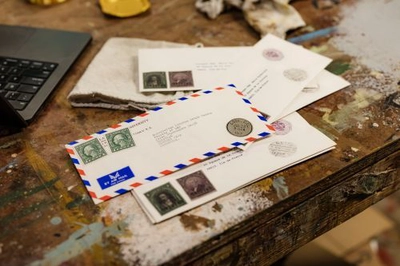
Some of the most labor-intensive props are the ones that end up in the trash every night. In the story, the Dowager Empress receives stacks of letters from "fake" Anastasias, which she crumples and rips on stage.
"We have to make a ton of copies because she rips them up,� Huckabay said. “To make them, I found images from online communities who are extremely obsessed with one particular thing, like old postage stamps."
This level of detail requires Huckabay to scour niche internet forums run by historical hobbyists to find the exact look of a 1917 stamp or a French telegram.
The hand-off from shop to stage
There is a definitive moment where the "art" of props becomes the "logistics" of stage management. Once the show opens, Huckabay’s design and build job is technically over, and the props are handed off to Angie Easterly, the props assistant stage manager.
Easterly maintains paperwork that tracks every prop from the second it leaves the wing to the moment it’s handed back off-stage. During rehearsals, she watches as the props get handled (or unintentionally mishandled, as can happen in the lively scenes of “Anastasia�).
“If anything happens with the props, the actors come to me and say ‘this broke’ or ‘this isn't working properly,’� Easterly said. “If I can't do anything about it right then, we'll put a note in our reports for the crew to fix it before the next run.�
When “Anastasia� finally takes its final bow, most of these items will head to the "Tinbug" storage unit adjacent to campus, to wait for the next story. But for now, they are the tangible layers that make the journey from St. Petersburg to Paris feel real.
See more photos of the prop shop
